supersonic fighter

supersonic fighter

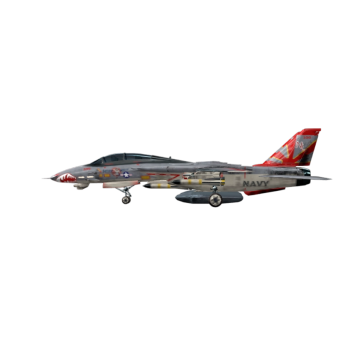
F-14 has participated in the Gulf War, the Kosovo War and other actual combat in history. Because the movie "Top Gun" (Top Gun) has become a global military cultural symbol, after retiring from the U.S. Navy in 2006, some of them are still serving in the Iranian Air Force (Iran is its only overseas user). Its variable sweep wing technology, long-range interception concept and iconic shape make it one of the most legendary fighters in aviation history.
United States USS Cleveland (CL-55) Cruiser

United States USS Cleveland (CL-55) Cruiser

The first ship of the United States Navy's Cleveland-class light cruiser, it was built during World War II. Named after the city of Cleveland, Ohio, it is the second ship to be named after this city. Construction began on July 1, 1940, was launched on November 1, 1941, and commissioned on June 15, 1942. As a new class of warship at that time, it was mainly active in the Atlantic and Pacific theaters during the war, participated in many important battles, and received 13 battle stars. It was decommissioned on 7 February 1947 and was sold for dismantling in 1960.
United States USS Northampton (CL/CA-26) Cruiser

United States USS Northampton (CL/CA-26) Cruiser

It is the first ship of the Northampton class cruiser of the United States Navy. Originally classified as a light cruiser, it was reclassified as a heavy cruiser under the London Naval Treaty. He served in the Pacific theater during World War II and was involved in several major operations. Sailed with the USS Enterprise during the Pearl Harbor incident on December 7, 1941, and returned to Pearl Harbor the next day. In 1942, he was involved in shelling operations on Warjay Island and Wake Island, and was counterattacked by Japanese forces during operations on Wake Island on 24 February. He was honored with six battle stars in World War II.
USS Essex

USS Essex

The first ship of the Essex-class aircraft carrier, it was built during World War II. It is the fourth warship of the U.S. Army to be named Essex, in honor of the donation of the first Essex ship to the U.S. government by residents of Essex County, Massachusetts in 1799. Construction began on April 28, 1941, was launched on July 31, 1942, and commissioned on December 31, 1942. He has participated in numerous campaigns in the Pacific theater, earning a U.S. Presidential Troop Citation and 13 Battle Stars. It was modernized after the war and returned to service in the early 1950 s. It was finally decommissioned on 30 June 1969.
United States USS Grand Rapids (CL-70/CAG-2) Cruiser
United States USS Grand Rapids (CL-70/CAG-2) Cruiser

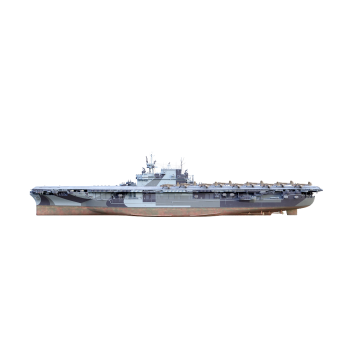
was a Cleveland-class light cruiser of the United States Navy, originally commissioned as a light cruiser and later reclassified as a light aviation cruiser. It was commissioned in 1945 and named after Grand Rapids, Michigan. He was involved in several World War II operations, including operations in the Pacific theater. Known for its fast sailing speed and powerful firepower, it is equipped with multiple main guns and anti-aircraft weapons. It was converted after the war into an aviation cruiser for carrying and operating helicopters, a new type of naval warfare capability for the time. Retired in the 1970 s.
USS Hornet (CV-8) aircraft carrier

USS Hornet (CV-8) aircraft carrier

A York City-class aircraft carrier of the United States Navy, it entered service on 20 October 1941 and was the third and final ship of this class. Commissioned a few weeks before Pearl Harbor, the ship was built before World War II and its dimensions were limited by international naval treaties of the 1930 s. The first mission was the Doolittle air raid in April 1942, the first American air raid on a Japanese home island and a response to the attack on Pearl Harbor. He continued to fight in the Pacific theater, participating in historic campaigns such as the Battle of Midway, but suffered a fatal blow in the Battle of the Santa Cruz Islands in October 1942.
United States USS Missouri (BB-63) battleship

United States USS Missouri (BB-63) battleship

It is one of the Iowa-class battleships of the United States Navy and the last battleship built in American history. Completed in 1944, it fought in the Pacific theater, including the battles of Iwo Jima and Okinawa, and shelled the Japanese home islands. The deck was the site of Imperial Japan's surrender, marking the end of World War II. In 1984, the Missouri was reactivated and modernized with the addition of cruise and anti-ship missile launchers and updated electronics. While serving in the Persian Gulf, he escorted tankers and provided fire support during Operation Desert Storm in 1991. Decommissioned in 1992
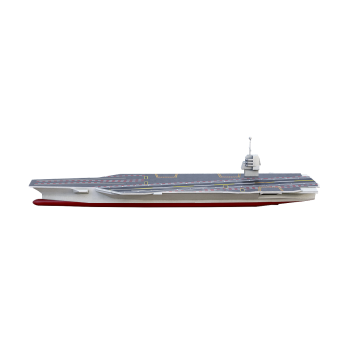
United States aircraft carrier USS Gerald R. Ford

United States aircraft carrier USS Gerald R. Ford

It is the first ship of the latest Ford-class nuclear-powered aircraft carrier in the U.S. Navy. It is named after the 38th President of the United States, Gerald R. Ford, who served on the USS Monterrey, a light aircraft carrier during World War II. A number of new technologies have been adopted, including electromagnetic aircraft ejection systems, advanced blocking devices, dual-band radars, advanced weapon elevators, etc., which have increased aircraft sorties and reduced personnel requirements. It is a large-scale mechanized combat platform and a brand-new information-based combat platform, which will have a great impact on future naval warfare. It is a central node in the future US naval and air cyber warfare.
USS Louisiana Battleship

USS Louisiana Battleship

It is a Connecticut-class battleship belonging to the United States Navy. The keel was laid on February 7, 1903 at Newport News Shipyard in Newport News, Virginia, launched on August 27, 1904, and commissioned on June 2, 1906. During his service, he was involved in a number of important missions, including carrying President Theodore Roosevelt to Panama to inspect the construction of the Panama Canal and participating in the circumnavigation of the "Great White Fleet" to demonstrate U.S. naval power. During World War I, the ship was used primarily as a training ship and assisted in the return of American troops from Europe to the United States after the war.
United States Mitscher-class destroyers

United States Mitscher-class destroyers

were four experimental large destroyers built by the US Navy shortly after World War II. It was larger than all previous destroyers, but was reclassified as Destroyer Leader during construction. It served in 1953-1954, two of which remained in service until 1969, and were dismantled in the 70 s. The other two were converted into guided missile destroyers, which remained in service until 1978 and were sold for dismantling in 1980. It was designed to test different propulsion systems and other equipment to determine the best option for future destroyer designs. The design and construction provided valuable lessons for future destroyer development for the U.S. Navy.
United States Navy 26-foot motorcycle lifeboat

United States Navy 26-foot motorcycle lifeboat

It was a multi-purpose vessel widely used during World War II. Designed by the Navy to withstand the impact of 20-foot waves and be able to perform tasks in extreme sea conditions, such as rescue in a storm or impact the hull without damage. Designed to be carried on naval vessels as lifeboats, officers' boats, shore group boats, mail boats, etc. The FRP structure far exceeds the general military specifications, can maintain the comfort of passengers during the mission, and has excellent handling performance and easy handling. It has a safe design, such as a circular passenger area. After decommissioning, it is often purchased by the private sector for various purposes, including leisure and commercial use.
United States Navy aircraft carrier

United States Navy aircraft carrier

It is an important part of American maritime power and has a long history of development. It is one of the first countries to develop aircraft carriers. Its first aircraft carrier "Langley" was modified from a coal carrier and officially entered service in 1922. Played a decisive role in World War II, rapidly expanding the carrier formation. He played a vital role in the key battles of the Pacific War. Aircraft carriers are famous for their huge displacement, the number of carrier-based aircraft, and combat efficiency. At present, all aircraft use nuclear power, which is an important manifestation of the global military influence of the United States.
USS West Virginia Battleship

USS West Virginia Battleship

It's a Colorado-class battleship. In 1944 played an important role in the Second World War. Construction began in 1921, was launched in 1923, and commissioned in 1925. It was hit hard at Pearl Harbor, but was then repaired and returned to combat. In 1944, he participated in important battles such as the Philippine Naval Battle and the Gulf of Reitai Naval Battle, and supported the US military with its strong firepower. Equipped with nine 16-inch guns, it was one of the most powerful battleships in the U.S. Navy at the time. Its performance in the war proved its value as an offshore firepower platform until it was decommissioned after the war and eventually dismantled.
USS Oregon

USS Oregon

It is a battleship belonging to the United States Navy and belongs to the No. 3 battleship of the Indiana class. It is the second U.S. military ship named after Oregon. Construction began at the Union Steel Shipyard in San Francisco in 1891, launched in 1893, and finally commissioned in 1896. He took part in the Spanish-American War and the US-Philippine War, and left Hong Kong after the Boxer Rebellion, taking the lead in carrying a small number of Marines to Dagu to protect the local American expatriates. It was decommissioned in 1919 and loaned to Portland in June 1925 as a memorial ship. After Pearl Harbor, the Navy increased military supplies. Sold for dismantling 7 December 1942.
US Nimitz-class aircraft carrier

US Nimitz-class aircraft carrier

It is a type of nuclear-powered multi-purpose aircraft carrier in active service under the U.S. Navy, as the core force of the U.S. Navy's ocean-going battle group. The length of the ship is 332.8 meters, and the width of the ship is 40.8 meters (hull) to 76.4 meters (flight deck). It can carry a variety of carrier-based aircraft for different purposes, such as F-14, F/A-18, etc., with a total of about 90 aircraft. Equipped with the "Sea Sparrow" missile launcher, the "dense array" short-range defense weapon system, etc., to provide a strong self-defense capability. With its powerful combat capability and almost unlimited endurance, it has become a symbol of US naval power and one of the largest aircraft carriers in the world.
USS Gerald R. Ford

USS Gerald R. Ford

It is the first ship of the latest generation of Ford-class aircraft carriers in the US Navy, representing the backbone of the US military's maritime strike force in the 21st century. It can carry about 75 to 90 aircraft of various types. Equipped with improved sea sparrow missiles, rolling fuselage missiles and dense array short-range defense weapon systems, it provides a strong self-defense capability. Thanks to its nuclear propulsion, the Ford has almost unlimited endurance and can store up to 60 days of food. Its entry into service marks a significant advancement in the U.S. Navy's aircraft carrier technology, with its design and capabilities surpassing its predecessor, the Nimitz-class, to become one of the largest aircraft carriers in the world in many respects.
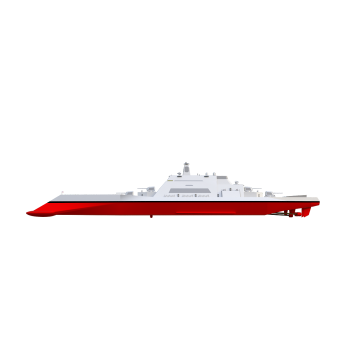
United States Constitution Class II Railgun Destroyer DDR-2000

United States Constitution Class II Railgun Destroyer DDR-2000

It is a next-generation main surface ship designed by the U.S. Navy to meet the needs of the future battlefield. From the 2041 Navy RFP, it aims to build the next generation of main surface ships to replace the aging Zumwalt-class and Arleigh Burke-class destroyers, as well as a limited number of Oregon-class warships. The design takes full advantage of the progress made in rail gun, laser and sensor technology in the past 30 years. The ship recommends artillery as the primary weapon system and focuses less on full stealth and more on balanced hull design and firepower. It was the first warship in history to incorporate railguns as a major aspect of its design.
United States USSJohnPaulJones(DDG-53) missile destroyer
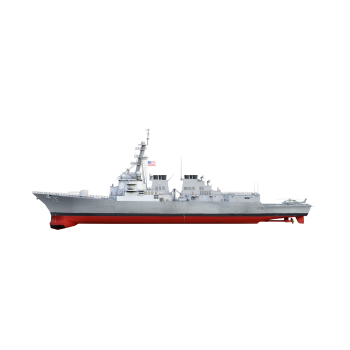
United States USSJohnPaulJones(DDG-53) missile destroyer

It is the third U.S. Navy Arleigh Burke-class guided missile destroyer and the first ship of this class to be deployed on the west coast. Named after the United States Navy hero John Paul Jones, he inherited his motto: "I wish to have nothing to do with any ship that does not gallop, for I intend to go down a dangerous path." Construction began on 8 August 1990 at Bath Steel Works, launched on 26 October 1991 and commissioned on 18 December 1993. It represents the modern combat effectiveness of the U.S. Navy and is equipped with the most advanced weapons, engineering and damage control systems.
American Arleigh Burke-class missile destroyer

American Arleigh Burke-class missile destroyer

It is a type of multi-mission surface warship of the United States Navy, known for its comprehensive combat capability. Able to operate independently or as part of carrier strike groups, surface action groups, amphibious reserve groups and supply groups. Heart is the Aegis combat system, which integrates the ship's sensors and weapons systems to counter anti-ship missile threats. The design focuses on stealth and protection capabilities. It is equipped with a "three defenses" filtration and ventilation system for nuclear, biological, and chemical warfare. The hull has a strong ability to withstand attacks. It was the first destroyer used by the U.S. Navy after World War II to adopt steel ships. With its strong combat capability and advanced technology, it continues to play an important role in the U.S. Navy.
American F-14 Tomcat fighter

American F-14 Tomcat fighter

It is a two-seater, two-launch supersonic carrier-based multi-purpose heavy fighter developed by the American Grumman Company (now Northrop Grumman Company) for the U.S. Navy. Mainly used for escort, fleet air defense, interdictions and close air support, designed to replace F-4 fighters. Development began in 1967, the prototype first flew on December 21, 1970 and was delivered in 1972. With the variable sweep mid-single wing design, the wing sweep angle can be automatically adjusted in the range of 20 ° to 68 ° to adapt to the best performance at different speeds and altitudes. The U.S. Navy retired its last F-14 in 2006.
American F/A-18FSuperHornet fighters

American F/A-18FSuperHornet fighters

It is the main carrier-based multi-purpose fighter in active service of the U.S. Navy. It is developed on the basis of F/A-18C/DHornet and has a larger fuselage and wingspan to improve performance and load capacity. It can perform a variety of tasks including air superiority, day and night strikes with precision-guided weapons, combat escort, close air support, suppression of enemy air defense, maritime strikes, reconnaissance, forward air control, and aerial refueling. Known for its excellent performance, adaptability and advanced characteristics, it is an indispensable force in the US Navy's aircraft carrier battle group. It has 11 external points and can carry all types of weapons of the US Navy.
During World War II, American warships such as the Iowa class battleships

During World War II, American warships such as the Iowa class battleships

The Iowa class battleships are the largest displacement class battleships in the United States Navy. Four Iowa class battleships have been completed, making them the longest, most powerful, fastest (reaching 33 knots), and latest decommissioned battleships in the world. Four ships of the same type are still preserved. Due to the cancellation of the Montana class, the successor ship to the Iowa class, this battleship became the last class of battleships in the United States Navy. On September 2, 1945, the signing ceremony of Japan's unconditional surrender, which marked the end of World War II, was held on the main deck of the USS Missouri anchored in Tokyo Bay, making the ship famous worldwide.
F-14 Fighter

F-14 Fighter

F-14 fighter (English: F-14 fighter, number: F-14, code/nickname: Tomcat, translation: Tomcat), is an American supersonic multi-role carrier-based fighter. The F-14 fighter has a two-seat, two-shot, two-tail, and one-wing layout. It was developed in accordance with the requirements of the U.S. Navy's fleet air defense and escort from the 1970 s to the 1980 s. It mainly performs fleet defense, interception, strike, and reconnaissance tasks.